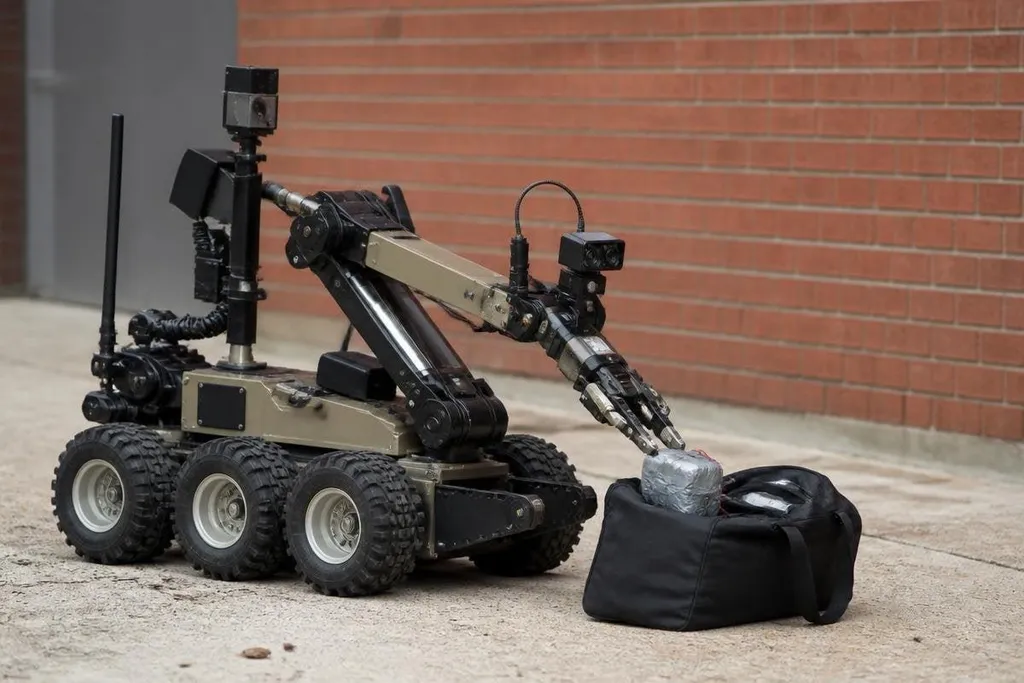
Bomb disposal robots let trained technicians inspect and handle suspicious objects from a safer distance. Their value comes from a linked set of systems: cameras, remote control, a mobile base, a robot arm, and tools for a specific task.
- Cameras give the operator a close view without sending a person beside the object.
- A tracked or wheeled base carries the arm, batteries, and safety equipment.
- The robot can inspect, move, or disrupt an object while the operator stays away.
How the robot sees
Most bomb disposal robots use several cameras rather than one wide view. A forward camera lets the operator drive, while cameras on the arm or tool give a closer look at an object. Pan, tilt, and zoom controls let the operator check a seam, wire, label, or opening from different angles.
The control system sends live video to a remote console. The operator may also receive views from thermal cameras or other sensors, depending on the robot and its mission. These tools can point out heat or movement that a normal camera might miss, but they don't identify every hazard.
Lighting matters too. A bright lamp mounted near the camera can reveal small details, while poor placement can create glare on metal or glass. A clear image lets the operator decide where the arm or tool should go next.
How it moves and reaches
Bomb disposal robots commonly use tracks because tracks spread the robot's weight and keep contact over rough ground. Wheels can give better speed on smooth floors, while a tracked base can make it easier to cross rubble or a curb. The choice depends on the site.
The arm carries the robot's main working tools. Its joints give the arm several degrees of freedom, which means it can move through different angles and place a tool near an object.
A gripper may lift a bag or remove a cover. A camera may inspect a narrow space. A water disruptor may be fitted when the team decides that task suits the situation.
Force control matters as well as position. Too little force may fail to move an object. Too much can damage the object or make the task less safe. Operators often make small movements while watching the live camera view, rather than sending the arm through a long automatic motion.
The operator’s view and the radio link need the same scrutiny as the arm. Bomb disposal robotics reporting can connect remote-handling claims to the robot, test setting, control method, and recorded limits. The next issue is the link itself: how commands reach the robot, and what happens when the signal weakens.
Remote control and communications
The operator usually drives the base and moves the arm from a console with joysticks, screens, and tool controls. The robot sends video and status data back over a radio or wired link. A wired link can limit movement but may give the team a dependable connection in a difficult site.
Remote operation brings a hard limit: the operator sees what the cameras see, not the whole scene. Dust, darkness, blocked views, signal loss, or a low battery can stop a task. The robot also can't make a safe decision from a video feed without human direction and a clear operating plan.
Some systems add assisted driving or arm control. These functions can keep the robot steady or stop a joint at its travel limit. They reduce workload, but they don't remove the need for a trained operator who can read the scene and choose the next action.
What the design must handle
A bomb disposal robot has to carry its own battery, drive system, radio, cameras, arm, and tool. That creates trade-offs in weight and reach. A longer arm can reach farther, but it can also make the robot harder to balance when it lifts an object.
The base must fit through doors and around vehicles. The arm needs enough reach to work from a safer position. The camera system must give a useful view while the robot sits at an angle or on uneven ground. Each choice affects the next one.
I'd skip any claim that a robot makes bomb disposal safe by itself. It gives technicians distance and more control over the task, but the risk remains at the object and in the decisions made around it.
A practical check before choosing one
Use this checklist when comparing a bomb disposal robot for a real team:
- Reach: Can the arm reach the object while the base stays on stable ground?
- Tool fit: Does the robot accept the tools your team already uses?
- Camera view: Can the operator see the gripper, tool, and object at the same time?
- Link type: Does the site need a radio link, a cable, or either option?
- Battery: Can the robot complete the planned task without a battery change?
- Training: Can operators practice the full control system before field use?
The next useful proof is a task record from the maker or agency using the robot: the object type, ground conditions, tool fitted, control link, and outcome. Without those details, a robot's arm reach or camera count says little about how it will perform beside a real suspicious device.